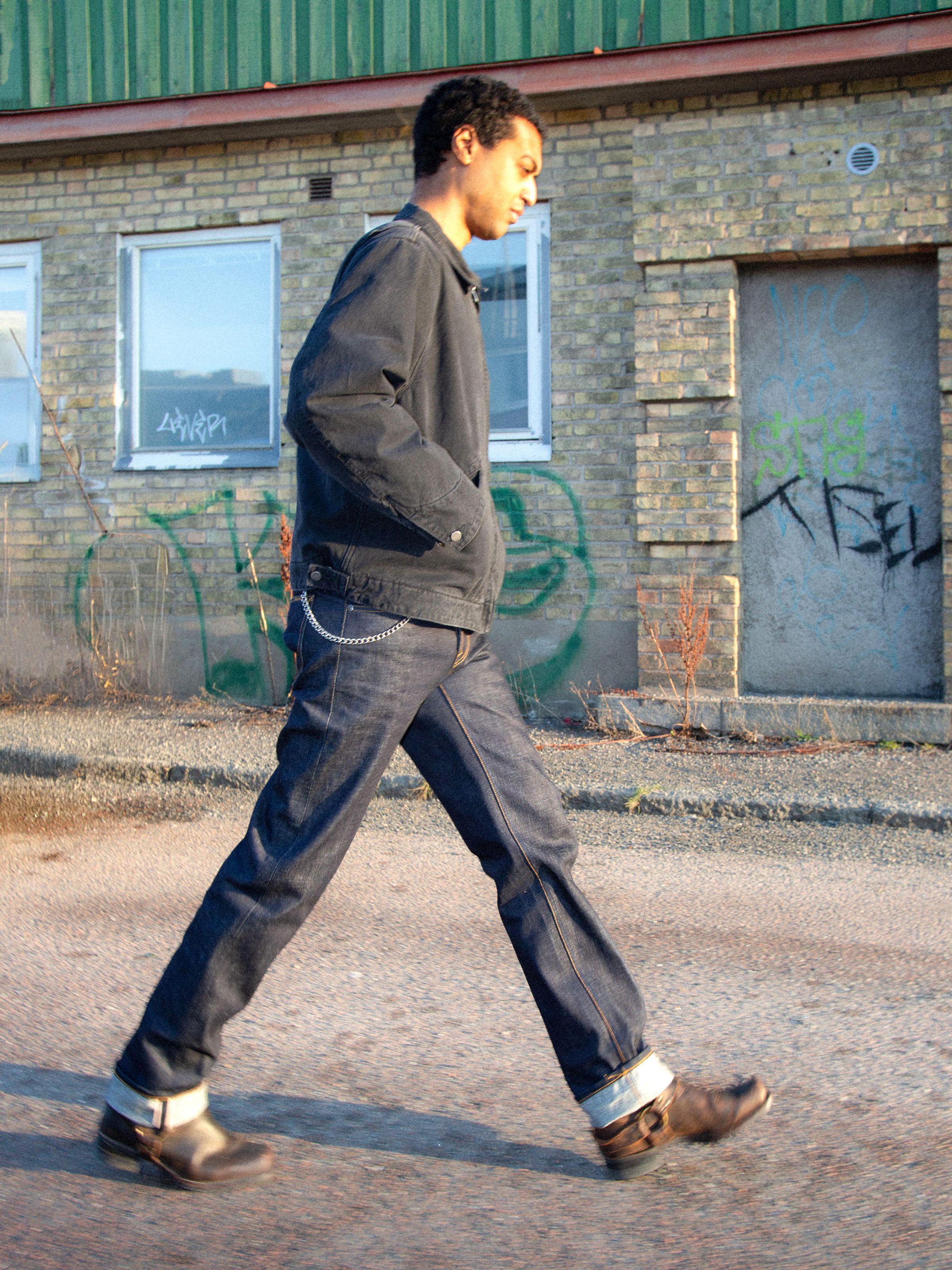
What is selvage (or selvedge) denim?
)
)
What is selvage (or selvedge) denim?
You know us so you know jeans are made from denim. Chance is you are wearing jeans right now, perhaps even dry – unwashed – selvage denim jeans.
Selvage, selvedge or selfedge, refers to the lengthwise edges of a fabric - its self-edge. To make things complicated it can be used to denote the edge of any fabric. But the selvage we refer to is obtained when a fabric is woven on a shuttle loom. An inherent trait of shuttle loom woven fabric is that the selvage is “self-bound” and cannot unravel, which is the key difference compared to denim made on “shuttle-less looms”.
Shuttle looms and selvage, how does it connect?
Weaving is one of the oldest techniques of producing fabric. And although significant technological advancements have been made the basic principles remain the same. There are two yarn systems, warp, and weft. In its original setting, denim is made with indigo-dyed warp yarns and undyed weft yarns. When weaving the warp yarns are stretched, and the weft yarns are inserted in between the warp and pushed into place. There are several ways of inserting the weft yarn, and often the insertion method is what gives the loom its name.
Originally a shuttle with a yarn bobbin was used to insert weft yarn, hence these looms are referred to as "shuttle looms". The shuttle is passed back and forth between the fabric edges at a maximum speed of about 200 insertions per minute. Due to the insertion method, the weft becomes continuously inserted until the bobbin in the shuttle runs out of yarn, at which point a new shuttle with a full bobbin exchange the empty. Shuttle looms, therefore, produce fabrics with stable edges, what we refer to as selvage. A benefit of these fabrics is that the stable selvage enables the garment maker to use the fabrics full width, and it can also be left as is without the need to be finished by an overlock- or felled seam.
Shuttle looms were the first loom to make woven fabric at an industrial scale, hence all woven fabrics made up until around the 1950s were selvage. It is therefore not unusual to find the selvage utilized on garments made before and around this time. Jeans are particularly notable for utilizing selvage in garment construction as they could be constructed with straight side seams. If folded at the hem the contrasting selvage would become visible, something that has become iconic for vintage jeans and in recent years crafted denim jeans. Ironically neither selvage nor fold-up was anything fancy or trendy. The selvage was kept minimizing fabric consumption, and the fold-up at the hem was necessary as the jeans would shrink somewhere around 10%.
Shuttle-less looms and fashion shows.
With an increased demand for textiles and an exploding demand for denim, the industry needed new technology to keep up with demand. Technological advancements were made throughout the value chain; from spinning that accepted shorter fiber length to finishing – the famous sanforization – that reduced shrinking. Notable in the context of denim is the development of rapier- and projectile looms which offer both faster weaving and wider output. These looms measure, insert, and cut the weft yarns leaving a fringe along the edges of the fabric. Contrary to a fabric woven on a shuttle loom these edges are not as stable, which is why they are often cut away and the pattern piece needs some form of finishing. In comparison to the shuttle looms 200 picks per minute rapier and projectile looms can weave at 1000. A shuttle loom fabric often has a width of about 80 cm while a rapier or projectile often has a width of at least 150 cm. Quite naturally shuttle looms quickly became an inefficient technology of the past.
Is selvage denim better, or just old news?
We believe selvage denim is the best denim there is. But if we are talking about durability or mechanical properties, we are not the ones to argue that selvage looms produce superior denim. That is if all conditions are the same, fiber length, yarn spinning, yarn density, construction, finishing etcetera. However, all the attention to detail that shuttle loom weaving requires can mean that the material and process choices made prior to weaving are more thoroughly thought through. But then we are comparing apples and pears. Instead, we believe that it is the aesthetics of selvage denim and the craftsmanship of its makers that make it the most superior denim in the world.
Why selvage is worth the trouble.
While all the hassle of using vintage shuttle looms trickles down and adds to the final price tag what is often overlooked is the makers and workers behind the fabric. The few that cherish knowledge from the old days, the ones that possess the patients and craftsmanship to create with tools of inferior speed and reliability to our modern society. The ones that are on the opposite end to fast fashion and mass consumption. If you ask us, it is these very people that create the best denim this world has ever seen. - Yes, the glory days of selvage denim are now. So, what our experience has thought us, and what we firmly argue is that selvage has superior aesthetical properties – how the denim looks and feels. The variations are caused by the imperfection of a vintage shuttle loom. The carefully composed relation between warp and weft yarns. The dyeing technique was chosen for the indigo yarns. The time and effort make all the difference as the denim ages into perfection.
Using selvage denim is our part of honoring the selvage artisans that keep the craftsmanship alive. Honoring those that inspire us and offering you the best denim this world has ever seen. That which will age into tomorrow’s vintage.
Why is selvage (or selvedge) denim more expensive?
We get this question a lot, why is selvage denim more expensive than normal dry (raw) denim or "regular" denim?
Here's the simple run down of why:
The craftmanship and artisians of selvage denim
Manual and slower production
Old shuttle looms
Historically made in Japan
The longer answer is that selvage denim requires craftsmanship. The production process itself is signified by its slower production speed, and lower output. As we explained above.
This makes the actual operation complex, and maintenance requires knowledge that is not necessarily possessed by your average loom technician. The actual production speed is also far slower than that of modern looms. Fabric width is about half of that from a modern loom, and output speed is around a fifth. So, roughly selvage output is somewhere around 10% compared to that of a modern loom. Another factor is where it is produced, we mainly use selvage denim from Japan. In Japan, denim is a craftsmanship to the fullest extent and this reflects on the price. While all of this adds to the final price of a selvage garment, there is more to selvage than just the price.
Wondering how to tell if a pair of jeans is made from selvage denim?
The easiest way is to cuff the jeans. If they’re selvage, you’ll see colored edge yarns—most commonly red. Ours are usually finished with our signature legacy orange thread.
But we’ve made it even easier: all our selvage products are behind the click of a button!
Selvage denim
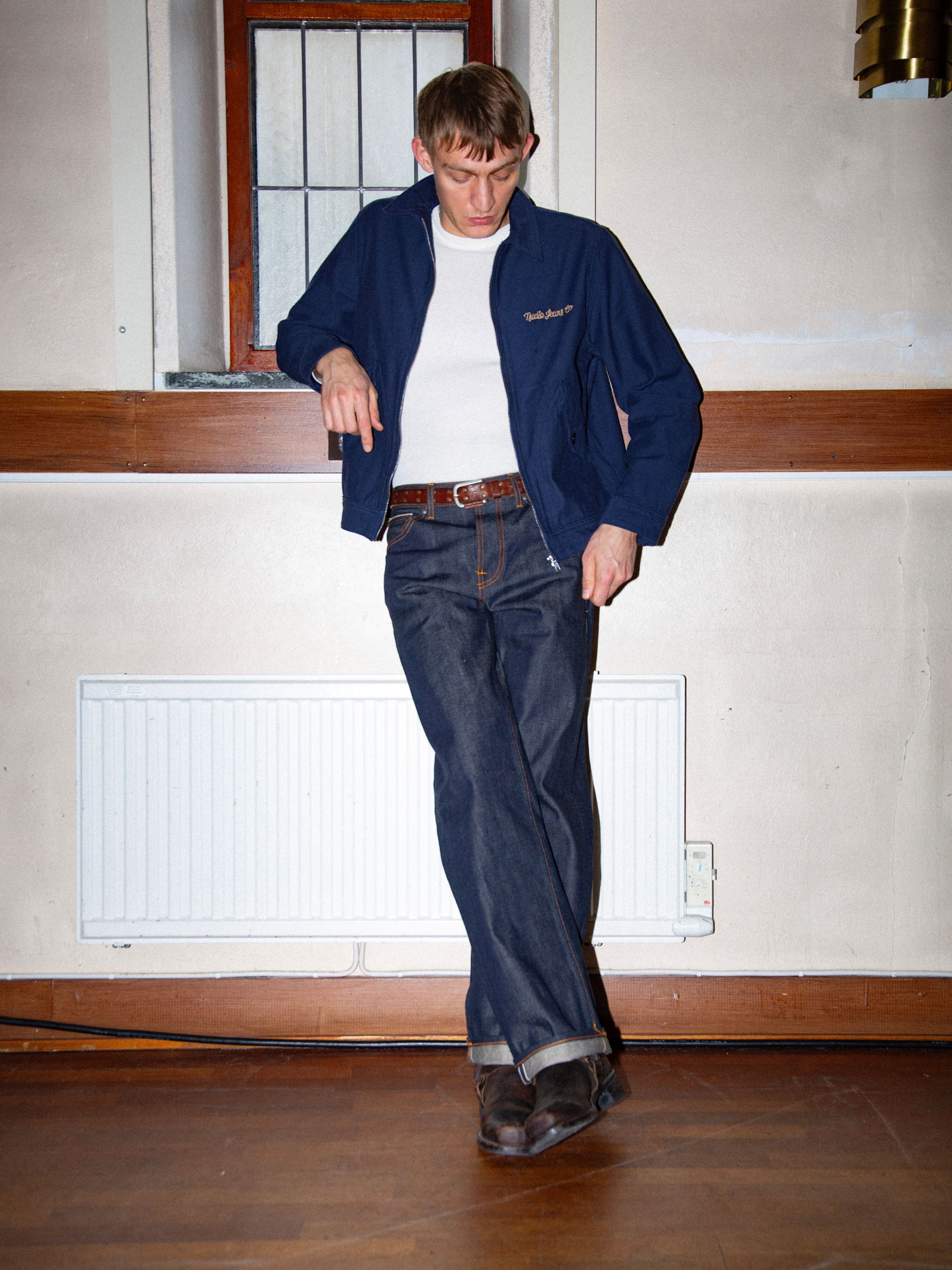
Tuff Tony Dry Selvage
63 800 JPY

Wide Heidi Dry Selvage
63 800 JPY

Loud Larry Dry Selvage
63 800 JPY

Gritty Jackson Dry Selvage
63 800 JPY
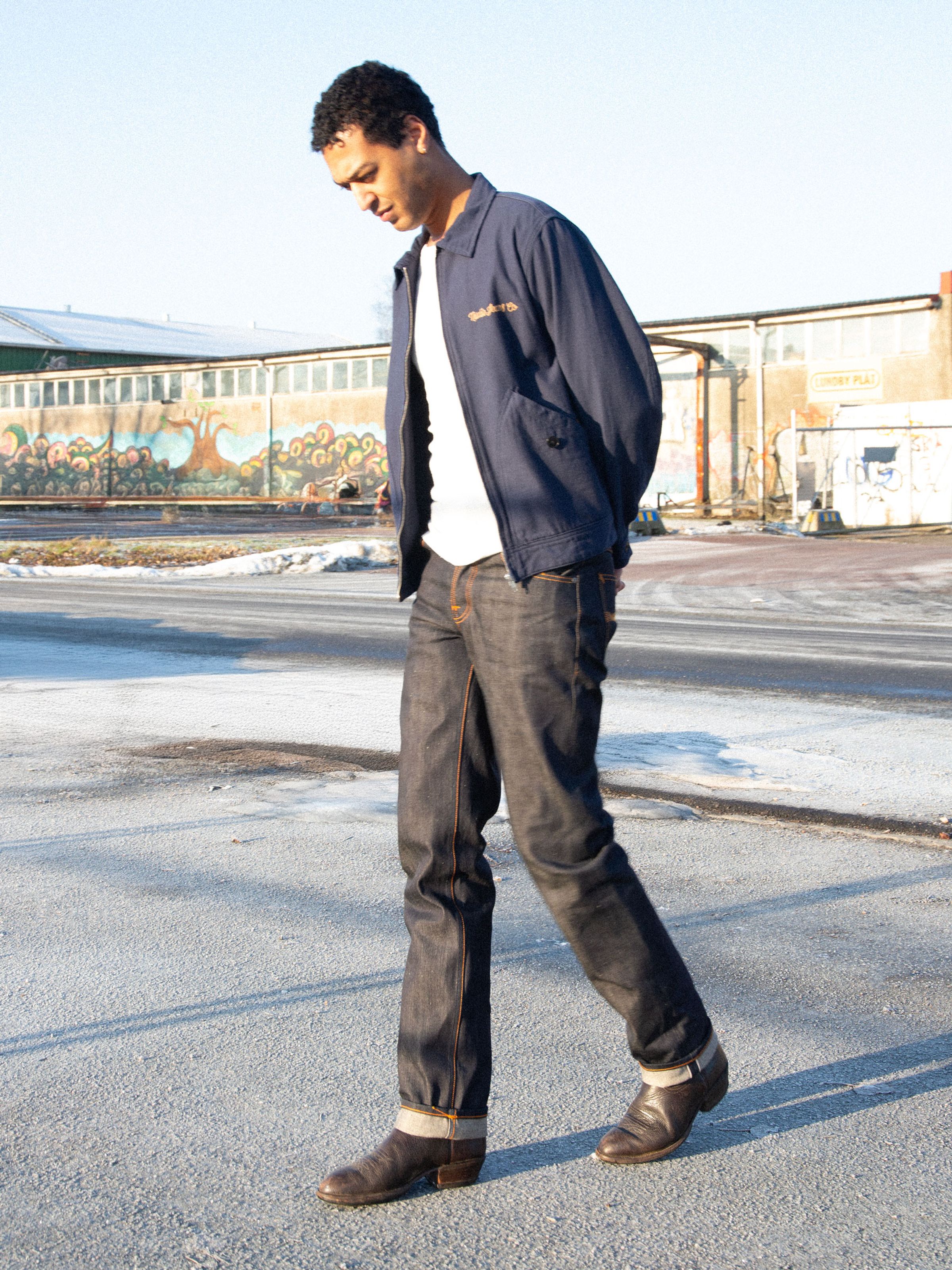
Rad Rufus Dry Selvage
63 800 JPY
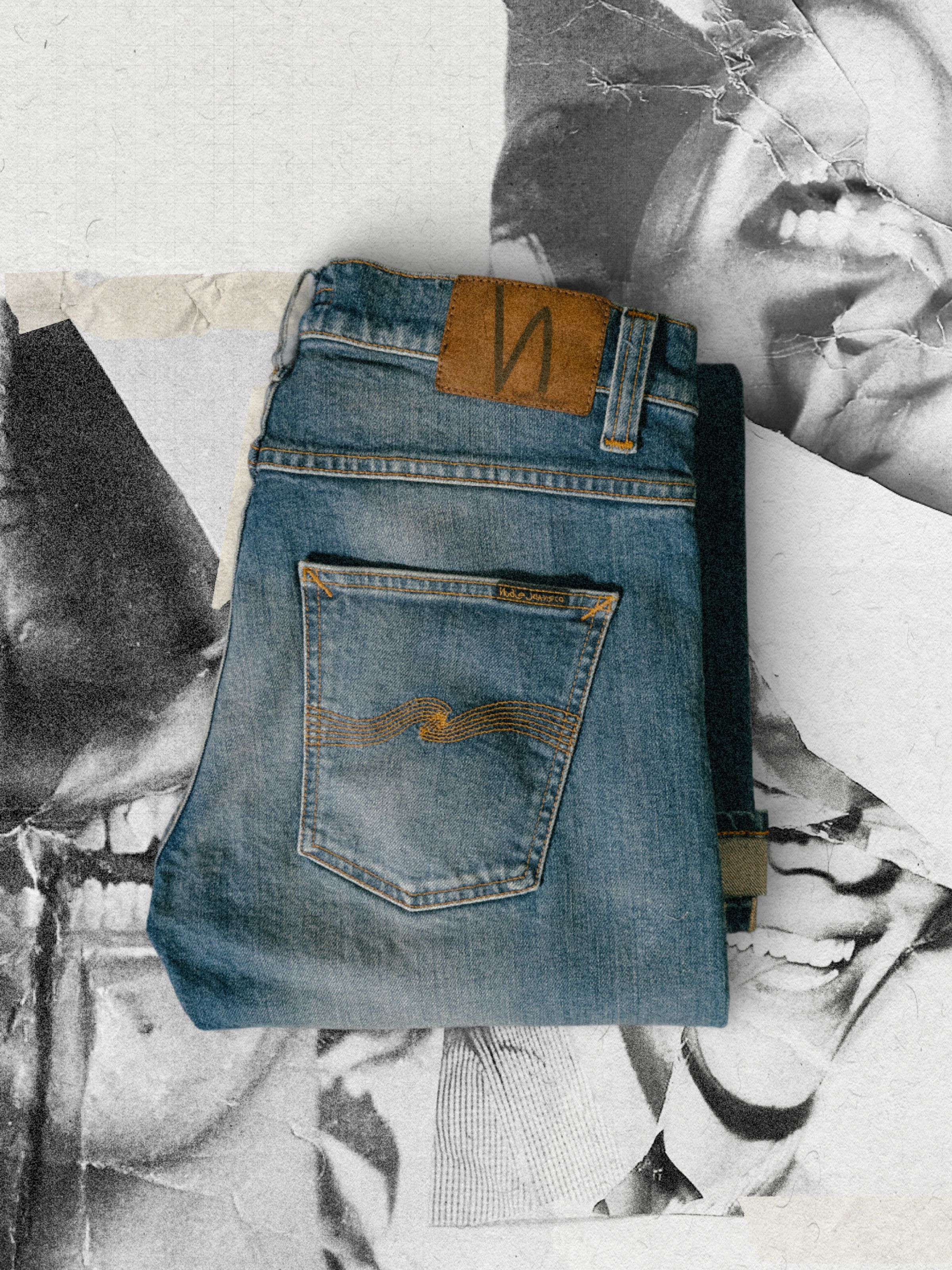
Grim Tim Ghost Selvage
58 300 JPY

Lean Dean Dry Japan Selvage
63 800 JPY
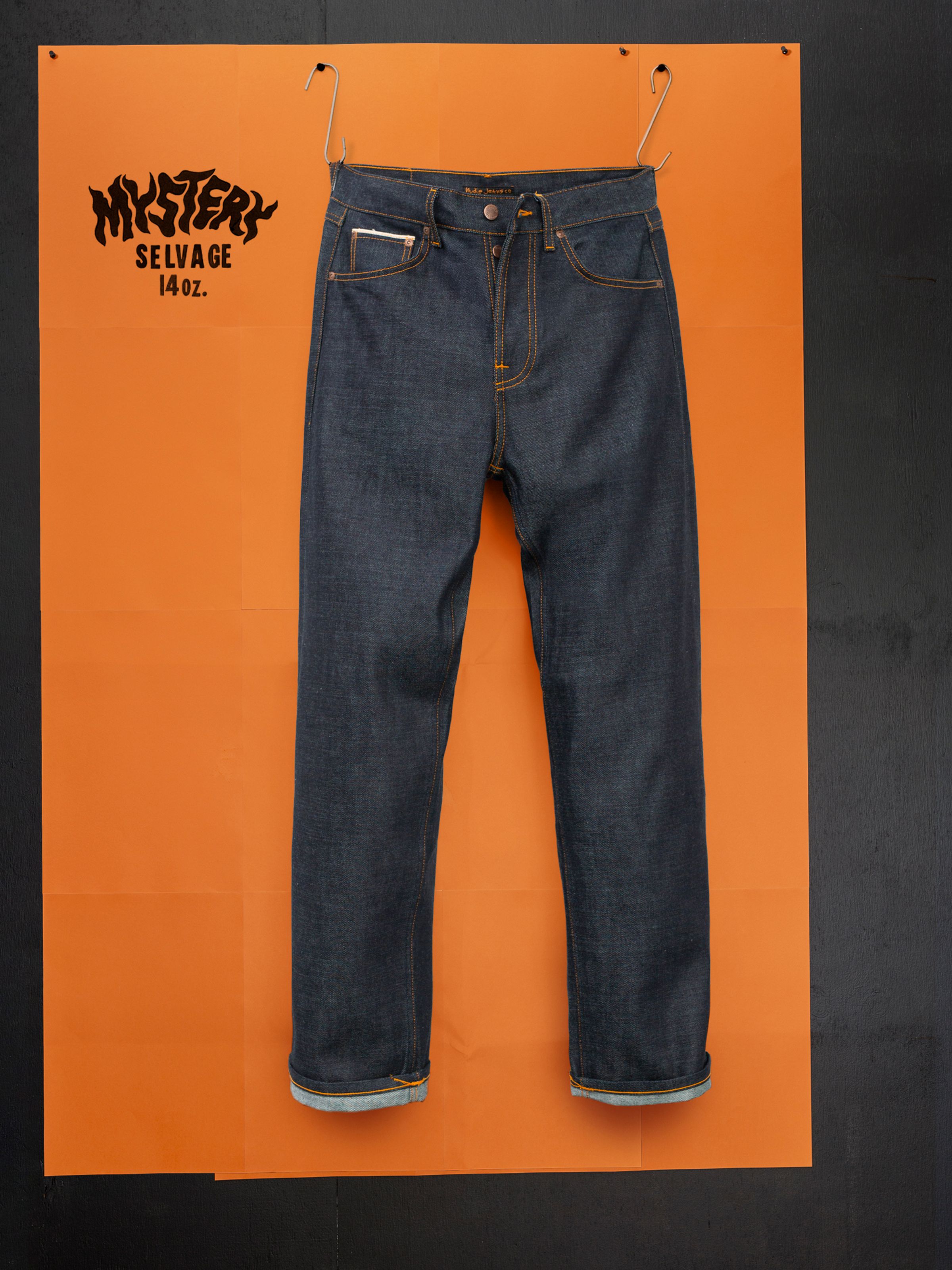
Tuff Tony Mystery Selvage
95 700 JPY

Gritty Jackson Dry Ace Selvage
88 000 JPY

Lean Dean Dry True Selvage
46 200 JPY

Tuff Tony Dry Ace Selvage
88 000 JPY

Clean Eileen Dry Twilight Selvage
52 800 JPY

Steady Eddie II Gravity Selvage
95 700 JPY

Steady Eddie II Dry Ace Selvage
88 000 JPY

Solid Ollie Dry Japan Selvage
63 800 JPY

Lean Dean Dry Apex Selvage
74 800 JPY